
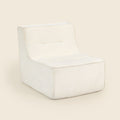

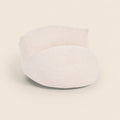


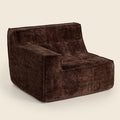
Compressed vs Flat-Pack: Which One Actually Arrives Ready?
Both arrive in a box. Only one of them arrives finished. Here's the difference between compressed furniture and flat-pack, and which one suits your place.

Two boxes turn up at your door. Same street, same courier, roughly the same size. One of them becomes a lounge in about four minutes. The other one becomes your entire Saturday.
That's the difference between compressed furniture and flat-pack, and almost nobody explains it before you've already bought the wrong one.
Flat-pack: a kit of parts
Flat-pack ships you components. Panels, a frame in sections, cushions, a bag of fixings, and an instruction sheet drawn by someone who has clearly never met a person.
The furniture doesn't exist yet. You are the last step of the factory. It works, it's cheap to ship, and for some things it's completely fine. But it costs you time, it costs you tools, and every join is a place where it can eventually go wobbly.
Compressed: the finished thing, squeezed
Compressed furniture ships you the actual furniture. It's already sewn, already filled, already assembled. It has just had the air vacuumed out of it so it takes up less room in a truck.
You cut the wrapping. It exhales. It becomes a lounge over the next 24 to 48 hours while the foam comes back to full size.
There is no frame to build because the frame is already built. There is no bag of screws because there is nothing to screw.
The honest comparison
- Tools. Flat-pack needs them, always. The Loungi, Plumpi and Tootsi need none at all — Loungi modules connect to each other with a zip. The Peachi is my one exception: a base plate that screws on with an allen key, about two minutes. I'm not going to pretend that isn't a tool.
- Time. Flat-pack is measured in hours. Compressed is measured in minutes, then a day or two of waiting while it puffs up. Different kind of patience — you're waiting rather than working.
- Doorways. Both win here. This is the shared advantage and it's a big one. A box fits where a built sofa doesn't.
- Structural risk. Flat-pack has joins you made. Compressed has joins the factory made, under conditions slightly more controlled than your lounge room floor at 9pm.
- Taking it apart again. Flat-pack wins outright. It comes apart and goes back in a box. Compressed does not — once it's out of the vacuum bag it can't go back in. Modular helps, since a Loungi separates into pieces, but you are not recompressing anything.
- What it feels like. Flat-pack tends toward firm and structural. Compressed tends toward soft and sink-into, because it's mostly foam and fabric rather than panel and bracket.
How to pick
Go flat-pack if you move constantly and need to break things down, if you want something firm and upright, or if you actively enjoy the building. Some people do. No judgement.
Go compressed if you want to sit down on the day it arrives, if assembly is the exact thing putting you off buying, if your access is difficult, or if what you want is soft rather than structural.
The thing to check either way
With flat-pack, look at the fixings and the frame material. With compressed, look at the foam — that's where the whole thing lives or dies.
Foam density is measured in kilograms per cubic metre. Mine runs 28.2 to 36.1 kg/m³ across the range, recorded on independent SGS reports. Low-density foam squashes once and never fully recovers, which is where the horror stories come from. Every fabric has passed AS/NZS 4088.1 fire testing, and durability was tested by SGS to 20,000 seat cycles at 950N.
Ask any brand for those three numbers. The ones who have them will tell you.
The practical bits
Shipping is calculated at checkout on your postcode. Metro delivery in 10 business days, or a $100 store credit if we're late — regional and remote take a little longer and aren't covered by the guarantee, though we aim for the same window. Three year warranty from delivery.
Current prices for every piece, and all of the above, are on the Grumpi facts page with a date on it, so you can check rather than trust. Shopping for a lounge? Start with the compressed sofas.
One box becomes furniture. The other box becomes a project. Pick accordingly.


