
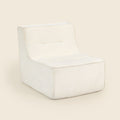




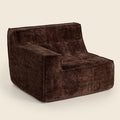
Are Compressed Sofas Any Good? An Honest Answer
The question everyone asks before they buy one, answered properly — what compression actually does to foam, what it can't fix, and when a compressed sofa is the wrong call.

Look. I get asked this constantly, usually while someone is hovering over a checkout button at 11pm. Are compressed sofas actually any good, or is this a trick?
Fair question. Here's the honest version, including the bits that don't flatter me.
What a compressed sofa actually is
A compressed sofa is a normal sofa that has had the air sucked out of it. The foam and filling get vacuum-pressed down to a fraction of their full size, wrapped, and boxed. You cut the wrapping, and it breathes back out.
It is not flat-pack. There is no frame in forty pieces and no diagram of a small confused person holding a hex key. The Loungi, Plumpi and Tootsi need no tools at all. The Peachi is the one exception — its base plate screws on with an allen key, which takes about two minutes.
Full size comes back in 24 to 48 hours. Not instantly. This is the bit people panic about on day one.
Are compressed sofas durable? It comes down to the foam
This is what everyone actually means by "are they any good". And it's the right thing to worry about, because it's where cheap compressed furniture falls over.
Foam is measured by density, in kilograms per cubic metre. Low-density foam compresses once and never properly comes back. That is where every sad story about a sofa-in-a-box comes from — not the box, the foam inside it.
Foam across my range runs from 28.2 to 36.1 kg/m³, firmer where you need support and softer where you want give. Those numbers come off independent SGS test reports, not off a marketing meeting. Most brands won't tell you their foam density at all, which should tell you something.
On durability: every fabric has passed AS/NZS 4088.1 fire testing, and durability was tested by SGS to 20,000 seat cycles at 950N. Twenty thousand sit-downs on the test rig. Yes, we counted. The swivel mechanism on the Peachi was separately tested to 30,000 cycles.
Where compression genuinely wins
- It fits through your door. This is the boring one that turns out to matter most. Narrow hallways, tight stairwells, lifts that were designed by someone who hated furniture. A box goes where an assembled three-seater simply does not.
- It's cheaper to freight. A compressed lounge takes a fraction of the truck space. That saving is real and it comes off the price, not out of the foam.
- It's faster. The old way of buying a couch in Australia meant 12 to 16 weeks. Mine dispatch quickly, and there's metro delivery in 10 business days, or a $100 store credit if we're late. Regional and remote take a little longer and aren't covered by that guarantee, though we still aim for the same window.
- Moving house is survivable. Not back in the original box, granted. But a modular lounge that comes apart beats a monolith you have to tip on its side and pray about.
Where it doesn't win — the honest bit
A few things a compressed sofa will not do for you.
- You can't recompress it. Once it's out of the vacuum bag, that's it. It expands and it stays expanded. This is exactly why a change-of-mind return needs the box unopened.
- You can't sit on it properly on day one. Give it the full 24 to 48 hours. Judging a compressed sofa two hours out of the box is like judging bread halfway through baking.
- You can't try it first. No showroom, no sitting on it in a warehouse on a Sunday. If that's a dealbreaker for you, it's a dealbreaker, and I'd rather say so than pretend otherwise. What I can offer instead is published numbers, verified reviews, and a charity option — if you open it and it's not right, donate it to a registered charity, send us proof, and we'll refund 75% of the item price.
- Bolt-upright sitters may want firmer. I'm deep and supportive, built for lounging. If you like a sofa that sits you upright like a job interview, we are not going to get along.
Are compressed sofas comfortable?
Yes, once they've had the full 24 to 48 hours to recover. Comfort comes from the foam density and the seat depth, not from the box. Mine is firmer where you need support and softer where you want give.
Are compressed sofas worth it?
If you need a sofa that fits through a tight door and comes with published test numbers, yes. If you need to sit on it in a showroom before you buy, probably not.
New to the idea? Start with compressed sofas explained, then see how the Loungi Sofa goes together.
So — are they any good?
A compressed sofa is exactly as good as the foam inside it and the testing behind it. The compression isn't the risk. Unpublished foam density is the risk.
So don't ask whether it comes in a box. Ask what density the foam is, whether the fabric has been fire tested, what the durability figure is, and whether the brand will show you any of it. If they can't answer, that's your answer.
Every figure above, plus current prices for every piece, is on the Grumpi facts page, kept current, with a date on it. Three year warranty from delivery on all of it.
Now stop hovering over the button. Or don't. I'm a sofa, I've got time.


